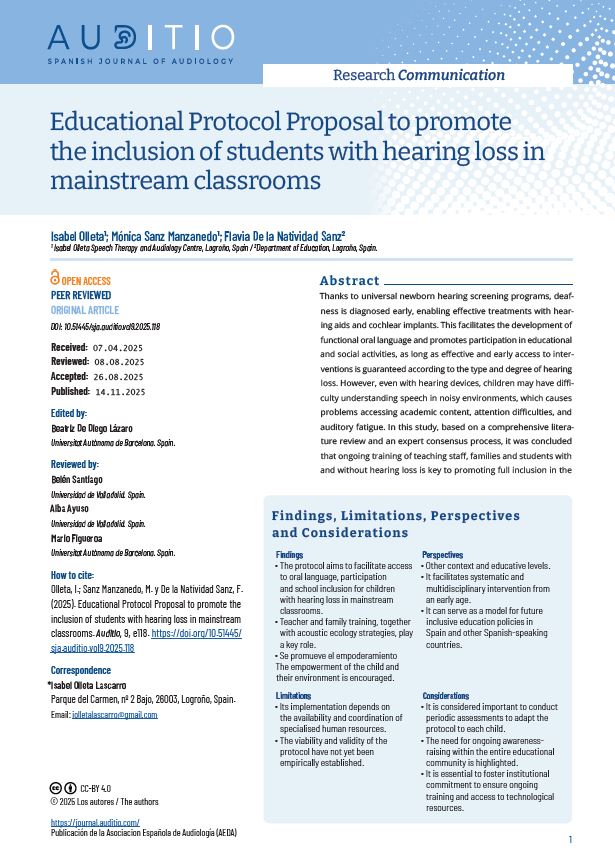
Educational Protocol Proposal to promote the inclusion of students with hearing loss in mainstream classrooms
DOI:
https://doi.org/10.51445/sja.auditio.vol9.2025.118Keywords:
Remote microphones, inclusion, noisy environment, language, auditory fatigueAbstract
Thanks to universal newborn hearing screening programs, deafness is diagnosed early, enabling effective treatments with hearing aids and cochlear implants. This facilitates the development of functional oral language and promotes participation in educational and social activities, as long as effective and early access to interventions is guaranteed according to the type and degree of hearing loss. However, even with hearing devices, children may have difficulty understanding speech in noisy environments, which causes problems accessing academic content, attention difficulties, and auditory fatigue. In this study, based on a comprehensive literature review and an expert consensus process, it was concluded that ongoing training of teaching staff, families and students with and without hearing loss is key to promoting full inclusion in the school environment for students with hearing loss. As a result, a proposed school-based protocol is presented to train teachers, students and families about the educational, technological and psychosocial needs of children with hearing loss. In future studies, it is planned to evaluate the efficacy of the protocol through indicators of participation, academic performance and socio-emotional well-being.
Downloads
Visibility and Altmetrics
Metrics
Global Statistics ℹ️
|
5024
Views
|
5010
Downloads
|
|
10034
Total
|
|
References
Alegre de la Rosa, O. M., & Villar Angulo, L. M. (2019). Attitudes of children with hearing loss towards public inclusive education. Education Sciences, 9(3), 244. DOI: https://doi.org/10.3390/educsci9030244
Astolfi, A., Puglisi, G. E., Murgia, S., Minelli, G., Pellerey, F., Prato, A., & Sacco, T. (2019). Influence of Classroom Acoustics on Noise Disturbance and Well-Being for First Graders. Frontiers in Psychology, 10, 2736. DOI: https://doi.org/10.3389/fpsyg.2019.02736
Bagatto, M. (2020). Audiological considerations for managing mild bilateral or unilateral hearing loss in infants and young children. Language, Speech, and Hearing Services in Schools, 51(1), 68-73. DOI: https://doi.org/10.1044/2019_LSHSS-OCHL-19-0025
Benítez-Barrera, C. R., & Olleta, I. (2024). Improving Listening at Home in Young Children with Hearing Loss. Audiology Today, 36(1), 32-40.
Calderon, R., & Greenberg, M. (2010). Social and Emotional Development 13 of Deaf Children: Family, School. In The Oxford Handbook of Deaf Studies, Language, and Education (Volume 1, pp. 188). DOI: https://doi.org/10.1093/oxfordhb/9780199750986.013.0014
CERMI Comunidad Valenciana. (2019). Protocolo de atención al alumnado con discapacidad en el ámbito educativo. https://cermicv.es/wp-admin/admin-ajax.php?juwpfisadmin=false&action=wpfd&task=file.download&wpfd_category_id=52&wpfd_file_id=1017&token=&preview=1
Chute, P. M., & Nevins, M. E. (2009). Serving students with hearing loss in the schools: Speech and language services for students in the mainstream. The ASHA Leader, 14(12), 12-15. DOI: https://doi.org/10.1044/leader.FTR1.14122009.12
Consejo Escolar del Estado. (2025). Informe 2024 sobre el estado del sistema educativo. https://www.libreria.educacion.gob.es/libro/informe-2024-sobre-el-estado-del-sistema-educativo-curso-2022-2023_185150/
Constantinescu-Sharpe, G., Phillips, R. L., Davis, A., Dornan, D., & Hogan, A. (2017). Social inclusion for children with hearing loss in listening and spoken Language early intervention: an exploratory study. BMC pediatrics, 17, 1-11. DOI: https://doi.org/10.1186/s12887-017-0823-y
Cooper, H.E., Statham, C., Kean, M., Davis, A., & Carr, G. (2025). Young children’s understanding of their listening environments: potential implications for the use of hearing aids. Deafness and Education International, 27(1), 52–70. DOI: https://doi.org/10.1080/14643154.2024.2413223
Crandell, C. C., & Smaldino, J. J. (2000). Classroom acoustics for children with normal hearing and with hearing impairment. Language, Speech, and Hearing Services in Schools, 31(4), 362-370. DOI: https://doi.org/10.1044/0161-1461.3104.362
Cruz-Iglesias, E., Urrutxi, L. D., Amondarain, M. G., & Fernández, I. L. (2025). Modelo de participación familiar en la respuesta educativa al alumno con discapacidad auditiva. Revista Colombiana de Educación, (94), e18450-e18450. DOI: https://doi.org/10.17227/rce.num94-18450
Cuetos, F., Rodríguez, B., & Ruano, E. (2007). PROLEC-R: Evaluación de los procesos lectores. Madrid: TEA Ediciones.
Dalmau-Montala, M., Balcells-Balcells, A., Giné, C. G., Pérez, M. C., Masjoan, O.C., Cuscó, Y.S., ... & Montserrat, N.C. (2017). Cómo implementar el modelo centrado en la familia en atención temprana. Anales de Psicología/Annals of Psychology, 33(3), 641-651. DOI: https://doi.org/10.6018/analesps.33.3.263611
Dalton, C. J. (2013). Lessons for Inclusion: Classroom experiences of students with mild and moderate hearing loss. Canadian Journal of Education, 36(1), 125-152.
Davis, H., Schlundt, D., Bonnet, K., Camarata, S., Hornsby, B., & Bess, F. H. (2021). Listening-related fatigue in children with hearing loss: Perspectives of children, parents, and school professionals. American Journal of Audiology, 30(4), 929-940. DOI: https://doi.org/10.1044/2021_AJA-20-00216
Del Carmen Morán-Avilés, G., & Pallaroso-Granizo, R. Y. (2024). Las emociones en la Prevención del bullying a estudiantes con hipoacusia. Portal de la Ciencia, 5(2), 164-180. DOI: https://doi.org/10.51247/pdlc.v5i2.437
Dockrell, J. E., Shield, B. M., & Rigby, K. (2004). Acoustic guidelines and teacher strategies for optimising learning conditions in classrooms for children with hearing problems. ACCESS: Achieving Clear Communication Empolying Sound Solutions. RC Seewald and JS Gravel, 217-226.
Dodd-Murphy, J., & Mamlin, N. (2002). Minimizing minimal hearing loss in the schools: What every classroom teacher should know. Preventing School Failure: Alternative Education for Children and Youth, 46(2), 86-92. DOI: https://doi.org/10.1080/10459880209603352
Dunn, L. M. (1997). Test de Vocabulario en Imágenes Peabody (TVIP). Madrid: TEA Ediciones.
Eriks-Brophy, A., Durieux-Smith, A., Olds, J., Fitzpatrick, E., Duquette, C., & Whittingham, J. (2006). Facilitators and barriers to the inclusion of orally educated children and youth with hearing loss in schools: promoting partnerships to support inclusion. Volta Review, 106(1). DOI: https://doi.org/10.17955/tvr.106.1.545
FIAPAS (Jáudenes, C. dir.). (2019). Estudio sociológico FIAPAS: Situación socioeducativa de las personas con sordera en España (2017/2018) (2ª ed.). Madrid: Confederación española de familias de personas Sordas- FIAPAS (2020). https://bibliotecafiapas.es/pdf/ESTUDIO-SOCIOLOGICO-2020-2ed.pdf
Fredricks, J. A., Reschly, A. L., & Christenson, S. L. (Eds.). (2019). Handbook of student engagement interventions: Working with disengaged students. Academic Press.
Furrer, C., & Skinner, E. (2003). Sense of relatedness as a factor in children’s academic engagement and performance. Journal of Educational Psychology, 95(1), 148. DOI: https://doi.org/10.1037//0022-0663.95.1.148
Genç, A., Doğan, M., & Çolaklıoğlu, O. (2023). Behavioral Problems in Children with Hearing Loss: A Comparative Analysis with Children with Typical Development and Autism Spectrum Disorder. Journal of Theoretical Educational Science, 16(4), 821-842. DOI: https://doi.org/10.30831/akukeg.1298252
Gheller, F., Lovo, E., Arsie, A., & Bovo, R. (2020). Classroom acoustics: Listening problems in children. Building Acoustics, 27(1), 47-59. DOI: https://doi.org/10.1177/1351010X19886035
Gheller, F., Spicciarelli, G., Scimemi, P., & Arfé, B. (2023). The Effects of Noise on Children’s Cognitive Performance: A Systematic Review. Environment and Behavior, 55(8-10), 698-734. DOI: https://doi.org/10.1177/00139165241245823
Gobierno de España. (2023). Real Decreto 674/2023, de 18 de julio, por el que se aprueba el Reglamento de las condiciones de utilización de la lengua de signos española y de los medios de apoyo a la comunicación oral para las personas sordas, con discapacidad auditiva y sordociegas. Boletín Oficial del Estado, núm. 174, de 22 de julio de 2023, páginas 100179 a 100221. https://www.boe.es/eli/es/rd/2023/07/18/674
Gustafson, S. J., Camarata, S., Hornsby, B. W., & Bess, F. H. (2021). Perceived listening difficulty in the classroom, not measured noise levels, is associated with fatigue in children with and without hearing loss. American Journal of Audiology, 30(4), 956-967. DOI: https://doi.org/10.1044/2021_AJA-21-00065
Hornsby, B. W., Camarata, S., Cho, S. J., Davis, H., McGarrigle, R., & Bess, F. H. (2022). Development and evaluation of pediatric versions of the vanderbilt fatigue scale for children with hearing loss. Journal of Speech, Language, and Hearing Research, 65(6), 2343-2363. DOI: https://doi.org/10.1044/2022_JSLHR-22-00051
Huyck, J. J., Anbuhl, K. L., Buran, B. N., Adler, H. J., Atcherson, S. R., Cakmak, O., ... & Steyger, P. S. (2021, October). Supporting equity and inclusion of deaf and hard-of-hearing individuals in professional organizations. In Frontiers in Education (Vol. 6, p. 755457). Frontiers Media SA. DOI: https://doi.org/10.3389/feduc.2021.755457
Keith, K., & Ross, E. (1998). Attitudes of a group of primary school teachers towards the educational inclusion of hearing-impaired learners in regular classrooms. South African Journal of Communication Disorders, 45(1), 39-50. DOI: https://doi.org/10.4102/sajcd.v45i1.717
Kirk, S. A. (2011). ITPA: Test Illinois de aptitudes psicolingüísticas (adaptación española). Madrid: TEA Ediciones.
Leines, S. D., García, E. C. E., Márquez, G. B., & del Consuelo Martínez-Wbaldo, M. (2022). Factores de riesgo asociados al trastorno de procesamiento auditivo central. Investigación en Discapacidad, 8(2), 51-61. DOI: https://doi.org/10.35366/105478
Lieu, J. E. C., Kenna, M., Samantha, A., & Davidson, L. (2020). Hearing loss in children: a review. JAMA; 324(21), 2195-2205. DOI: https://doi.org/10.1001/jama.2020.17647
Maggio De Maggi, M. (2004). Cuestionario Auditivo Escolar para la valoración de los sistemas Roger y FM 3/3. Life UK, canning (1999). Traducción y adaptación. Programa Infantil Phonak.
Maggio De Maggi, M., & Calvo, J. C. (2021). Accesibilidad auditiva en el aula. En FIAPAS (Jáudenes, C. coord.) (2021): Entornos educativos digitales inclusivos y accesibles. Guía para el apoyo a la comunicación oral del alumnado con sordera. Madrid: Confederación FIAPAS.
Manrique, M., Cervera-Paz, F. J., Huarte, A., Martínez, I., Gómez, A., & Vázquez de La Iglesia, F. (2004). Audición y lenguaje en niños menores de 2 años tratados con implantación coclear. In Anales del Sistema Sanitario de Navarra (Vol. 27, No. 3, pp. 305-317). Gobierno de Navarra. Departamento de Salud. DOI: https://doi.org/10.4321/S1137-66272004000500003
Mapolisa, T., & Tshabalala, T. (2013). The impact of inclusion of children with hearing impairment into regular schools: A case study of Dakamela primary school in Zimbabwe. International Journal of Asian Social Science, 3(7), 1500-1510.
Martin, D., Bat-Chava, Y., Lalwani, A., & Waltzman, S. B. (2011). Peer relationships of deaf children with cochlear implants: Predictors of peer entry and peer interaction success. Journal of Deaf Studies and Deaf Education, 16(1), 108-120. DOI: https://doi.org/10.1093/deafed/enq037
McCreery, R. W., Walker, E. A., Spratford, M., Lewis, D., & Brennan, M. (2019). Auditory, cognitive, and linguistic factors predict speech recognition in adverse listening conditions for children with hearing loss. Frontiers in Neuroscience, 13, 1093. DOI: https://doi.org/10.3389/fnins.2019.01093
McGarrigle, R., Gustafson, S. J., Hornsby, B. W., & Bess, F. H. (2019). Behavioral measures of listening effort in school-age children: Examining the effects of signal-to-noise ratio, hearing loss, and amplification. Ear and Hearing, 40(2), 381-392. DOI: https://doi.org/10.1097/AUD.0000000000000623
McKellin, W. H., Shahin, K., Hodgson, M., Jamieson, J., & Pichora-Fuller, M. K. (2011). Noisy zones of proximal development: Conversation in noisy classrooms. Journal of Sociolinguistics, 15(1), 65–93. DOI: https://doi.org/10.1111/j.1467-9841.2010.00467.x
Minelli, G., Puglisi, G. E., & Astolfi, A. (2022). Acoustical parameters for learning in classroom: A review. Building and Environment, 208, 108582. https://doi.org/10.1016/j.buildenv.2021.108582 DOI: https://doi.org/10.1016/j.buildenv.2021.108582
Monsalve González, A., & Núñez Batalla, F. (2006). La importancia del diagnóstico e intervención temprana para el desarrollo de los niños sordos: Los programas de detección precoz de la hipoacusia. Psychosocial Intervention, 15(1), 7-28. DOI: https://doi.org/10.4321/S1132-05592006000100002
Núñez, T., F., Jáudenes, C., Sequí, J. M., Vivanco, A., & Zubicaray, J. (2021). Sordera infantil con discapacidad asociada (DA+): recomendaciones CODEPEH 2021. Revista Fiapas, (178, Especial). (2ª ed.). Madrid, FIAPAS 2022.
Olleta, I. (2018). Atención temprana del niño con déficit auditivo de 0 a 6 años: cómo asesorar e informar a la familia en todo su desarrollo. Santa Cruz de Tenerife: Asociación Española de Audiología.
Oswald, A. M. M., & Ostojic, S. (2020). Curating more diverse scientific conferences. Nature Reviews Neuroscience, 21(11), 589-590. DOI: https://doi.org/10.1038/s41583-020-0373-4
Picou, E. M., Ricketts, T. A., & Hornsby, B. W. (2013). How hearing aids, background noise, and visual cues influence objective listening effort. Ear and Hearing, 34(5), e52-e64. DOI: https://doi.org/10.1097/AUD.0b013e31827f0431
Prakash, S. S. (2012). Inclusion of children with hearing impairment in schools: A survey on teachers’ attitudes. Disability, CBR & Inclusive Development, 23(3), 90-111. DOI: https://doi.org/10.5463/dcid.v23i3.117
Rekkedal, A. M. (2015). Students with hearing loss and their teachers’ view on factors associated with the students’ listening perception of classroom communication. Deafness & Education International, 17(1), 19-32. DOI: https://doi.org/10.1179/1557069X14Y.0000000040
Sánchez-Sánchez, F., Fernández-Pinto, I., Santamaría, P., Carrasco, M., & del Barrio, V. (2016). SENA, Sistema de Evaluación de Niños y Adolescentes: proceso de desarrollo y evidencias de confiabilidad y validez. Revista de Psicología Clínica con Niños y Adolescentes, 3(2), 23-34.
Toro, J., Cervera, J., & Díaz, J. (2015). TALE: Test de análisis de lectoescritura. Madrid: CEPE.
Trinidad, G., & Jaúdenes, C. (2011). Sordera infantil. Del diagnóstico precoz a la inclusión educativa. Guía práctica para el abordaje interdisciplinar (2ª ed.). Madrid, Confederación Española de Familias de Personas Sordas –Fiapas (2012).
Tzovara, A., Amarreh, I., Borghesani, V., Chakravarty, M. M., DuPre, E., Grefkes, C., ... & Badhwar, A. (2021). Embracing diversity and inclusivity in an academic setting: Insights from the Organization for Human Brain Mapping. NeuroImage, 229, 117742. DOI: https://doi.org/10.1016/j.neuroimage.2021.117742
Vázquez Mosquera, M. C. (2021). Comparación del perfil neurocognitivo entre niños de 3 a 6 años con y sin discapacidad auditiva. Revista Eugenio Espejo, 15(3), 38-48. DOI: https://doi.org/10.37135/ee.04.12.05
Walker, E. A., Curran, M., Spratford, M., & Roush, P. (2019). Remote microphone systems for preschool-age children who are hard of hearing: access and utilization. International Journal of Audiology, 58(4), 200-207. DOI: https://doi.org/10.1080/14992027.2018.1537523
Werfel, K. L., & Hendricks, A. E. (2023). The contribution of phonological processing to reading and spelling in students with cochlear implants. Language, Speech, and Hearing Services in Schools, 54(3), 967-980. DOI: https://doi.org/10.1044/2023_LSHSS-22-00129
Downloads
Published
How to Cite
Issue
Section
Categories
License
Copyright (c) 2025 Isabel Olleta, Mónica Sanz Manzanedo, Flavia De la Natividad Sanz

This work is licensed under a Creative Commons Attribution 4.0 International License.
All articles will be published under the open Creative Commons Attribution (CC-BY) license. This license allows others to share and adapt the content, even for commercial purposes, as long as appropriate credit is given to the authors and the journal. By submitting their manuscript, authors retain copyright but grant the journal the right to make the first publication under this license.
More information about this license is available at: https://creativecommons.org/licenses/by/4.0/
Articles published between 2001 and 2020
The texts published in this journal in the section "AUDITIO 2001-2020" are subject - unless otherwise indicated - to a Creative Commons Attribution 3.0 Spain license. You can copy, distribute, communicate them publicly, make derivative works and commercial uses provided that you acknowledge the credits of the works (authorship, name of the journal, publishing institution) in the manner specified by the authors or by the journal. The full license can be consulted at http://creativecommons.org/licenses/by/3.0/es/deed.es.